Friday, January 24, 2014

Informationally Modified Awareness

The headline read: PURPLE TOMATOES HEADING FOR SHOPS.  According to the report, "Their dark pigment is intended to give tomatoes the same potential health benefits as fruit such as blueberries. … The pigment, known as anthocyanin, is an antioxidant which studies on animals show could help fight cancer."

The report is a good example of how mind control works in the Global Corporate State.  To see how, we must step back and do something that will soon be illegal: remember.


"The new tomatoes could improve the nutritional value of everyday foods"
[BBC Caption]

Thousands of minutes ago, back in December 2013, there appeared a report in the mudia-sphere on how "VITAMIN SUPPLEMENTS DO NO GOOD, RESEARCH SHOWS."  We chipsters are given to popping supplements on a more or less regular basis and so we were curious what the research actually showed.

As it turns out (reading the actual report), the research showed the doses of supplements did "no good" at reversing the condition of a 69 year old diabetic.  This, under the inimitable stupidity of journalists, got truncated into "does no good" … the inference being, "at all."

The inaccurate story popped up in a variety of sources around the world, so that if someone wanted to malign supplements this was the way to go about it.  Well…  journalists, as we said, are stupid and this is particularly the case with mainstream "responsibilized" journalists.

However about two weeks later, the other side of the coin got turned up.  Headlines blared: SUPPLEMENTS RISK FATAL LIVER FAILURE.  Wow! Now that is scary.  There is a big difference between doing something that does no good and doing something that will kill you.  And, needless to say, the report reported very grim details about another grossly overweight diabetic, former alcoholic who took hyper-mega doses of some weird vitamin that killed him.

Nevertheless, in an abundance of caution we asked our doctor if the typical doses of multi-vita, beta-50, calcium, this and that could kill us.  "No," he said, "but they won't do any good."  "You sound like a doctor from the Fifties," we replied. He laughed, "Yes, odd that." The latest research, he repeated, found no evidence that supplements do any good.

We were not entirely convinced.  The two stories together certainly plotted the trajectory of an anti-supplement campaign, if there were one.  In fact, we do know that the U.S. FDA has been champing at the bit to "regulate" supplements; translation: to make them another "nexus" for medico-corporate profit and control.

So, we filed the Issue under "Pending Alerts" or "Inactively Remembered."

Now comes the BBC story about purple tomatoes.  Why are these especially good and desirable?  The report tell us because the contain "anti-oxidants." 

But wait!  But wait!  Aren't "anti-oxidants" the thing that vitamins and supplements are supposed to contain?  How can they "do no good" and at the same time "help fight cancer" ?

Marmosets Muddled.

The article continued: "The tomatoes are part of a new generation of GM plants designed to appeal to consumers.     ….   Canadian regulations are seen as more supportive of GM and that led to a deal with an Ontario company, …

According to a one Prof. Martin, the Canadians "look at the trait, not the technology, and that should be a way we start changing our thinking - asking if what you're doing is safe and beneficial, not: 'Is it GM and therefore we're going to reject it completely'.  … I hope this will serve as a vanguard product where people can have access to something that is GM but has benefits for them."

A "vanguard product" to "change our thinking"… you know, the way Wonder Bread changed the way we thought about worthless fluff.   Of course, Professor Martin has already changed his thinking, so what he really means is that the Purple Tomato is here to change your way of thinking.

And your way of thinking is not to wonder how the "new tomatoes"  could manage to improve the nutritional value of melons, pork, rice  milk and other "foods."

So listen up all you unmodified dolts:  Supplements are No Good-Killers and "antioxidant  enhanced" purple tomatoes are Helpful in Curing Cancer.  Do the Right Thing for your body!


Saturday, January 4, 2014

Wizmography


WIZMOGRAPHY is the science of cluttering simplicity with useless functionalities poorly explained.

Wizmography appears to have a lucri causa  inasmuch as it is based on the notion that: you can do more with more. Since we all want to do our most (so that we can acquire most) we go out and purchase a program which will allow us to do as much as possible in every conceivable way.   Of course, while most of us are fundamentally capable of the proverbial "anything," most of us also discover that we do best when we limit ourselves to working on one or a few things at most.  As they say, "less is more."

Alas, the New Year ran us straight into the toils of wizmography.

With Auld Lang Syne fondness for an Old Application forced forgot, we chipsters have reluctantly moved our chipping operation onto Intel's block.  Running an outdated program in emulation on an outdated PPC platform was less and less of an option as  progre$$ moved relentlessly on.

That left us looking for a word processing program to replace the venerable Word Perfect.  Alas, again,  there is none; not for writers at least.

Since we had had some not entirely awful experience with Appleworks we looked at Apple's latest office suite app, Pages.   There, on its home page,  -- in unmistakable applestyle -- was a very spiffy and bright picture of a letter-sized page with an over-sized and radiantly colorful picture of a butterfly, next to which there appeared a four line caption in barely visible Ariel grey.  Wow!  That's quite a dissertation there.

We clicked away.  Obviously Apple knows nothing about writing.  You know… that stuff whose boring, colorless graphics consists of the alphabet.  Yes, the alphabet,  Mother of All Graphics. 

So after more clicking we downloaded LIBRE OFFICE, a free, open source, copy-lefted, collaborated, cross-platform, cross-border effort.  We like the idea of Anarcho-Coding and fervently hope it succeeds in tumbling the walls of corporate monopoly, exploitation and oppression.  But a word processor Libre Office is not.

As with most of the Suite Gang, Libre Office confuses printing with writing and although it offers a cornucopia of neat and nifty stuff for  printing, presenting publishing, linking, hypertexting, spread-sheeting, and databasing, it provides nothing for the process of writing -- that is for the process of thinking with the aid of an alphabet.  Word Perfect was and remains the only application which understood what would better be called word scratching than word processing.

Here is a draft of Karl Marx's Capital


Here is a draft of Beethoven's Fidelio


Here is the "work console" for Microsoft Office.
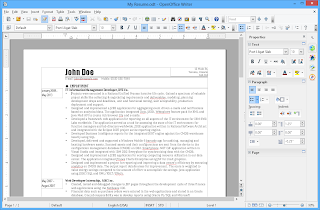


We have little hesitation in pronouncing that nothing of profound or lasting value will ever be written on Microsoft Office.

The reason for this is that thought takes place in the brain and writing serves as an act of of instant remembering which both reflects and objectifies our thoughts. 

Sometimes thought unfolds laboriously with great eye-furrowing effort in which case the act of writing serves as a form of calculation which allows us to test our own thoughts by following implications and extracting inferences.  Other times, writing gushes forth in furious cascades of sentences or half sentences reflecting a rapid almost confused and seamless sequence of concepts called "insight".    Writers furiously scribble these insights out, and just as furiously scratch them away when the articulation is not right.  It may be that one word triggered the realization that what was being written did not quite correctly reflect what was then and there being understood, but that one word negated the whole sentence of words that flowed from and connected to it.  Scratch it all again…  replace with…

Word processing programs that tell you (oh miracle of science!) that  Shift-Opt-Right Arrow will "delete three words to the right of the cursor" confess in that one boast that they haven't the foggiest notion of what composing is about.

LIBRA OFFICE, we are sorry to say, espouses the Command Console approach to "word processing."  The approach is actually made worse by the fact that not only are commands invokable by key or by drop down lists but by point and clicking on various places on the page.  In other words, if your hand rests a little too heavily on the mouse while the cursor is nearish the top of the page, the Header Pop Op pops up.  If the cursor is elsewhere something else pops up.  The result is a bad psychedelic experience or something like training in urban warfare.

Pleasingly enough, however, all this clutter CAN be clicked way, leaving something similar to the Word Perfect "blank page to type on."  THAT achieved, all we needed was some very simple basic formatting mostly involving page numbers.

"Omnes relinquite spes, o vos intrantes


The instructions on Inserting Page Numbers began:

To Insert Page Numbers

Choose Insert - Fields - Page Number to insert a page number at the current cursor position.If you see the text "Page number" instead of the number, choose View - Field names.  However, these fields will change position when you add or remove text. So it is best to insert the page number field into a header or footer that has the same position and that is repeated on every page.

Choose Insert - Header - (name of page style) or Insert - Footer - (name of page style) to add a header or footer to all pages with the current page style

If you would like to define a different format or modify the page number, insert a field with Insert - Fields - Other and make the desired settings in the Fields dialog. It is also possible to edit a field inserted with the Page Numbers command with Edit - Fields. To change page numbers, read the Page Numbers guide.

To Start With a Defined Page Number

Now you want some more control on page numbers. You are writing a text document that should start with page number 12.
    1.        Click into the first paragraph of your document.
    2.        Choose Format - Paragraph - Text flow.
    3.        In the Breaks area, enable Insert. Enable With Page Style just to be able to set the new
               Pagenumber. Click OK.
    4.       The new page number is an attribute of the first paragraph of the page.


Who the hell formats this way?  We are fairly confident that perhaps .0001% of the population insert page numbers into the first (or even subsequent) paragraphs of text on a page, and that .0001% is locked away in lunatic asylums.

Most people place a page number at either the left, right or center of the top or bottom margins of the page.  When the designers of a program start talking about floating page numbers, that does not bode well for the future.

After several hours of wracking our brain over not very comprehensible instructions and following those instructions to the "T" but to no satisfactory result in real-click time, we finally managed to get a footer to work so as to  place 1, 2, 3 . . . at the bottom of the first, second and third pages. 

But that was only the first circle of hell.  We needed to format Table of Contents which could be any number of pages in length and which needed to be numbered with Roman lower case numerals as in    i, ii, iii . . .

A day (sic) later we had managed to build a document which contained whatever controls were needed to allow for x numbers of roman numeral pages followed by y number of Arabic numbered pages. 

Two days later, we are still trying to figure out how to add a no-number title page to the whole shebang.  One would think that creating a title page and then importing the roman/arabic number file (or "template") would do the trick so as to create another Grand Composite Template consisting of Title Page, Table of Contents pages and Text Content  pages.  But nooooooo….. It just doesn't work.  The numbers either go all roman or all arabic or disappear altogether.

During our experimenting we tried to delete a page.  We could not find an instructions on how to do this, and whenever we blocked a page, the "cut" symbol on the menu bar became inactive.  We finally figured out (by mere accident mind you) that the way to delete a page is to place the cursor at the lower right and scroll up and back and then hit "cut".

We fear that at this point it would be easier to install DOS in emulation and run Word Perfect on that basis.'

We have no objection to creating a "suite" which enables people to paste pretty pictures of butterflies, to build colorful graphs and pie charts,  to repeat a lexicon of prefabbed burbles, to create vast libraries of so-called templates and styles and automatically control such tasks as creating an outline in the mind taxing format of I, A, 1. a. (1) (a) . . .  But we wish that there would be an option to : dispense with all that other shit and allow simple basic line spacing, centering, indenting, footnoting  and page numbering.  The trick is, Oh ye Techies, it is not complicated and requires no wizmography.

©WCG 2014

Saturday, October 19, 2013

Chiaroscuro In God's City

       
foto by roski :)
Most of this year, we have been listening to music by Juan Gutierrez Padilla an early 17th century Mexican composer who became maestro de capilla at the Puebla cathedral which was completed in 1649 and for which i have a familiar attachment going back generations.

As cantor and then chapel-master, Padilla wrote sacred music, although from the sound of his villancicos we might hardly know it.  Villancicos were popular liturgical songs composed for feast days, including Christmas, and often accompanied by dramatic processions. 

It is perhaps off the mark to refer to "popular liturgical music", because the word liturgeia originally meant the "work" of the "people" (laios).  But, in all events, villancicos do not have that somber, disciplined melodiousness which characterises chant and sacred polyphony. 

In fact villancicos are a musical riot. In Spain they are often built around the sesquiáltera, a dynamic rhythm employing strong syncopations derived from Arabic sarabands.  But indigenous Mexico had sarabands of its own, most prominently huapangos or "thumpings" which were percusive rhythms marked out by dancing feet on a stage of resonating wooden planks.  Arab and Aztec meet in Padilla's villancicos under the umbrella of Renaissance.

In 1596, Phillip II forbade the further use in his court of villancicos or anything not sung in Latin.  But no one, including Puebla's Archbishop Juan de Palafox y Mendoza paid any heed.  One did not have to await Vatican II for popular liturgies, at least not in Puebla.  While Europe sank into Pietism and Counter-Pietism, Mexico was apparently enjoying itself.


It would be equally mistaken, however, to think that Padilla's other sacred music is lacking in syncopation, arrests, puns and other innovations, although my ignorant ear was deaf to them.  Beautiful and soothing as his sacred choral polyphonies were, the overall first impression was still that of multi-voiced chant.  You know, that Palestrina stuff. 

But it is not that Palestrina stuff.  It is that Padilla stuff, uniquely Spanish and Mexican.  I found the beauty irresistible and the more i repeatedly listened to the compositions the more the different voices began to emerge in distinct relief -- like blurred friezes coming into focus. 

The "syncopations" were easy to get.  Padilla put them into Glorias and Credos because "the Indians liked them." But he also employed fugues and counter-point, which is why his music is technically Baroque.  Like so much in Mexico his music looks backward and forward at the same time.  

Over time, with much listening, the pieces of his intricate sonic kaleidoscope come into distinct hearing filling me, at least, with a kind of serene awe.

Like all musicians (including the great Bach) Padilla falls back on "stock phrases". At times Padilla seems to exalt the music over the text which is a big no-no when one is dealing with sacred texts.  But at other times, his music gives a flattening force to words, which they simply do not have on their own. I say "flattening" because not only is one "bowled over" but everything else is squeezed out leaving only consciousness of the words which sink in and fill up.

A case in point is his very short piece Velum Templi Scissum Est -

"And the veil of the Temple was rent in the middle and all the earth trembled.  The thief cried out from the cross, saying: Lord remember me when thou comest into thy Kingdom."  

The words are just a narrative rendered trite by familiarity and license. But when intoned the metaphor comes to life and it simply cuts you open. Did the Indian, i wondered, hearken back to the chacmol and if so did he see the new in the old way or the old in a new way?  The music dispels the question; for it pushes beyond formulation and into the realm of archetype. 


Another example is the Lamentations of Jeremiah often called Lamentations for Maundy Thursday.  Literally, the lamentation is for the desolation of Jerusalem but Padilla's score brings out the deeper psychological meaning as an existential lamentation for the city that each of our souls is.  It is the music of pure despair when all that was has withered and disappeared and turned.

Between these lamentations and the villancicos lies a chiaroscuro that is common in Latin countries and particularly characteristic of Mexico. 

But perhaps the thing that has impressed me most about Padilla's polyphony -- and polyphony in general -- is that it is sung without the artificiality of instruments.  The incredibly rich, layered and counterpuntal sound arises entirely from the natural voice of the human animal so that the voice of man becomes the quintessence of birds. 

Now, i like a good bellow from the pipes, blast from the horn, whistle from the flute and strain from strings as much as the next guy; but i am verging on the opinion that these things actually detract from perfection.

The voice that emerges from polyphony is that of human voices plying together in such social harmony as to produce a sonorous unity which must certainly be the sound of a City of Angels. 


---oOo--- 


P.S.  For anyone interested, i strongly recommend the performances by the Cappella Rutenberg  for his choral works.  Unfortunately i was not able to find any clips of this group's performances.  However, the mixing and mastering is superior to that of other CDs.  The group does not use any instrumentation to fill in gaps or smooth out edges.  Lastly, in my opinion, the pace is slower and, as a result, better.  The slower pace tends to "hide" Padilla's bouncy rhythms making them less obvious and more intriguing.   With villancicos which were instrumental "theatrical" performances are another matter and i've found quite a few good renditions with the usual interpretative variations.


Tuesday, May 7, 2013

The Anonymous Eye


By chance we came across the photos of a previously unknown and unpublished photographer who anonymously took pictures of people on the streets of New York during the Fifties.

The mostly black and white pictures were taken in six by six format on a Roloflex and are simply stunning in their sharp capturing of texture and gradations of light.  To say that they are superbly focused somewhat misses the point.  Even though, on a computer, the pictures are two digitations away from the original analogue print, the pictures are sharp without the tracing delineation of digital captures. 

The salient characteristic of all 100 or so photographs i viewed was one of unremitting hardness.  The hardness of poverty, hardness in privilege, hardness of nails, hardness of sidewalks, the hardness of childhood. 

There was almost no motion among the subjects who stood like pillars in plexiglass against a backdrop or horizon of walls in what ultimately became the many mansions of hell.

The beauty of the photographs arises from their artistry alone, not from what they depict which is more depressing than any German Expressionism whose freakishness becomes funny.   There is no laughter here.

The  photographs remind us that the Fifties were not quite the happy googah of Mel's Drive In; that poverty and grime was not confined to Appalachia, and that New York  -- for all the fondness that a personal nostalgia might bear -- was unbearably ugly, a place from which the Hand of God had been withdrawn.

Paradoxically Vivian Meier worked all her life as a private nannie.  Her work can be seen at http://www.vivianmaier.com/

.

Thursday, October 27, 2011

Piecing together the Confusion


BBC and Der Spiegel have both reported on the recomposition of the destroyed Andra Mantegna fresco in the 13th century church of the Eremitani, in Padua, Italy.

The church was destroyed during an Allied bombing raid in March 1944, reducing the majestic fresco to dust and chunklets.

The church was rebuilt after the war, but restoring the fresco presented seemingly insurmountable problems, as the only pictures of the work were in black and white.

But through the Miracle of Math, artists and mathematicians have been able to recompose the fresco using algorithms to "paint" the colour gradations between the extant pieces or "points" of the picture.


So at least we have a cyber fresco. But if this is possible, why not a holographic reconstruction of the Roman Forum?

And if we can mathematically reconstruct the Forum, why not also the events that took place in it? If we have reported "chunklets" of history, why not use algorithms to fill in the unkown spaces between event-points?

The days of Star Trek's holodeck are nigh! And this is truly a fascinating prospect; for, if we can "dial into" whatever holographic replay of the past we want, why not decide to live in whatever era we chose? At age 21 we would have a choice of which historical period we want to live in (for life).

All this, thanks to Allied bombing.

According to Der Spiegel, the Church of the Eremitani blasted to smithereens during a raid on "nearby" German headquarters, and this event-piece of the "reconstructed past" was found in several other places on the net as well.

Uh... how nearby? We have been to Italy, and one remarkable thing (at least to hemispheric Americans) is how small the cities are. Is the crowded downtown of crooked, narrow streets the place for a "headquarters" in the middle of a war? It is certainly possible, but the more likely place -- easily and quickly accessible by vehicles -- would be on the more modern outskirts of the city.

So we went agoogling.

Not surprisingly, there was no confirmation of the "headquarters" excuse. It is beyond dispute that the Church of the Eremitani was destroyed during a bombing raid on 11 March 1944, conducted by the US Army 2nd Bombardment Group (H), 429th Squadron. (The Second Was First (1999) ISBN 0-9675054-0-2.)

The sortie log states:

"Twenty aircraft dropped 60 tons of 500-lb. GP bombs on Marshalling Yards on the west side of Padua."

"Photos showed considerable damage in the north yards and direct hits on repair sheds and warehouses."

The photos show:

(www.trenidicarta.it/bombesuibinari/padova.html)


That hardly looks like centre-ville. But just to make sure, we googled an aerial map of Padua showing the location of the Marshalling Yards and the Eremitani Church.


The sortie log for the Bomber Group, states,

"Confusion over the target resulted in two runs being made on the target. The first time over, the rear half of the Group dropped its bombs while the forward half did not for fear of dropping bombs on another Group on a different axis of attack. The whole Group went over the target a second time and the forward half bombed."
Quite some confusion!

Actually, the confusion was the result of General Indifference. For bombing purposes Italian cities were ranked "A" "B" "C". "A" cities were off limits. "B" cities were subject to slow go special case bombing. "C" cities were "who gives a fuck?"

Padua was classed "C"


"This is the story of the men of the Second Bombardment Group (Heavy) .... They were the cream of America’s youth. May their names, and deeds, never be forgotten."

.

Monday, October 10, 2011

Does Research Make You Stupid?


The UK Independent runs a story today entitled "Does Running make You Fat?" This nugget of sagacity explains "Many of us take up jogging to help lose weight. But the latest research shows it could have just the opposite effect. Sophie Morris, who ran a marathon and ended up heavier, explains why."

It turns out that Sophie Morris pigged out after her runs. ""People gravitate towards rewarding themselves after exercise with sweet treats," says researcher James Duigan. Morris confirms by informing us that her runs were accompanied by "Two breakfasts, minimum, and then protein-based snacks before and after runs. Ah yes, and the cake"

Does anyone know the meaning of "it"? Running did not have the opposite effect, overeating did.

Well running tends to cause people to overeat does it not? No. Some of the blobbiest people I see are riding shopping carts down the candy aisle at Walmarts, and I am scientifically certain that they don't run -- or jog -- anywhere. It -- jogging or running -- did not cause them to blob out and waddle down the candy aisle. Sugar did.

The problem with all these health and medical research studies is that they don't adhere to the simple rules of grammar and thus create a confusing profusion of "astonishing new discoveries" which conflict with "astonishing old discoveries" leaving the public beaten into perpetual befuddlement by too much cheap information.

Everyone's metabolism and body is slightly different. But within a general range certain evident rules apply. Exercise expends calories. The body wants to replenish the calories expended. This is known as hunger. If you replace what you spend, you will stay the same weight. If you replace less, you will loose weight and if you replace more you will gain weight. The trick is managing one's hunger and understanding what foods trigger more hunger than they satisfy. The answer once again is : sugars. (Sugar, refined grains, junk foods.)

After a long intense run, most people do want quick-energy; that is, sugar. In what is certainly an amazing act of telepathic or gravitational communication (worthy of a study), the Snickers bar on the counter triggers the salivary glands. "An apple is rarely appealing after you've worked up a sweat," our researchers inform us. Well.... duh. What are we trying to do? Are we trying to indulge our tastebuds or get into shape?

"We feel we have worked hard and desrve a reward...." Well... duh again. What kind of reward do we want? Do we want the reward of tasty food or do we want the reward of looking good because we are in fact feeling good? It is amazing how much "research" and much "training advice" simply distracts people from making clear cut decisions and sticking with them.

The Independent article goes on to provide a bunch of interesting statistics on how low level aerobic activity (raking leaves) stimulates more hunger more quickly after work than high intensity anaerobic activity which tends to depress hunger, but how, on the other hand a balance of 27.5% low level aerobic + 32.5% hi intensity anaerobic aerobic excercise followed by 50% medium intensity resistance training will achieve the optimum hunger suppression/stimulation ratio.... Or whatever.

The eager acolyte, after hours on his or her butt figuring out the best possible routine, then tries to accomodate his work outs into the appropriate breakdown... has a miserable time, tries to tune out from the whole grim process by listenign to stock options on his iThing while jogging, doesn't pay attention to that little soreness around the ankle, injures himself and (with secret relief at having a bona fide excuse) "skips" the morning run while rustling up some bacon and eggs.... and toast n' jam.

Isn't it wonderful we live in the Age of Research?
.

Thursday, August 25, 2011

Pasta al Pesto Alfredo Bruselas

  1. Boil spaghetti or fetuccini.
  2. Boil brussel sprouts cut in half or quarters until al dente
  3. In a pan, sauté and burn cut garlic cloves in generous bath of olive oil
  4. Season with cut basil
  5. Mix seasoned pasta and brussel sprouts.
Optionally, stir in sour cream and parmessan cheese to taste.

This is not haute coosine. In fact, it isn't even coosine bas. It is simply a chow-mix for the would be vegetarian who is going nuts trying to figure out what to eat.

.